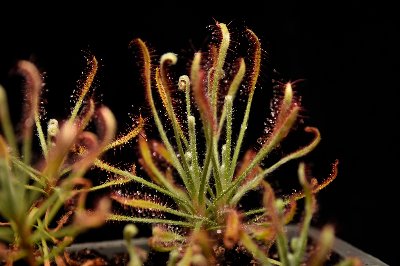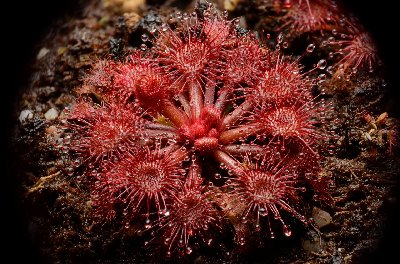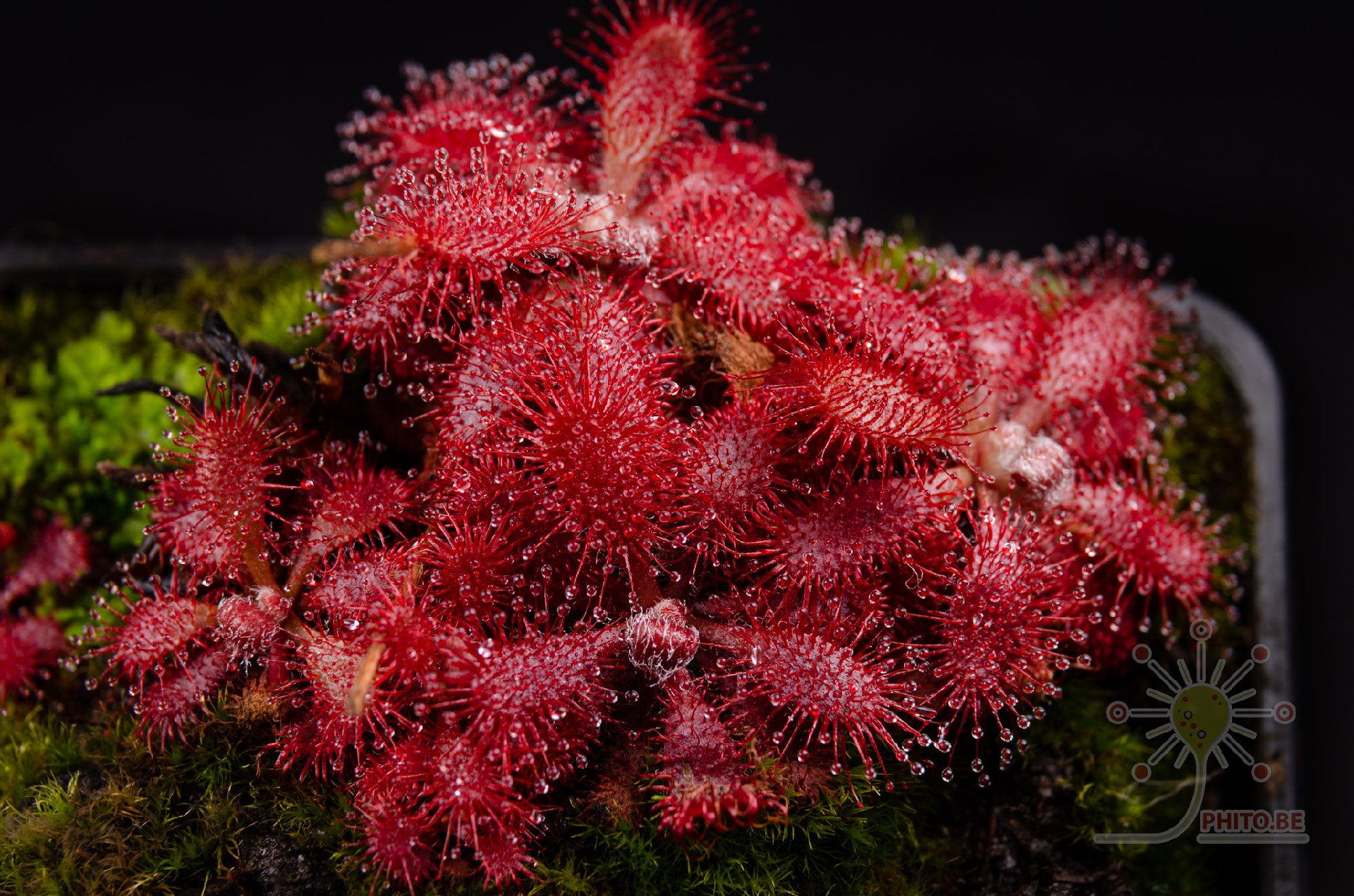
Drosera tomentosa var. tomentosa
{Morro do Jambeiro, Brazil}
Probably the most common sundew of the Brazilian campos rupestres in the wild. Originally described by Saint-Hilaire in 1826, it spent over a century lumped under D. montana before being restored to full species rank in 2014. The name tomentosa refers to the woolly, non-glandular hairs that densely cover the flower scapes, the key feature that separates this variety from var. glabrata, which has only glandular hairs on its scapes.
It grows across eastern Brazil's Espinhaco Range, from southern Minas Gerais north to the Chapada Diamantina in Bahia, at 700-2050 m. You'll find it in sandy and peaty soils around seepages, on cracked sandstone outcrops, and along the margins of seasonal springs and rivers. It is known to hybridize naturally with members of the D. villosa complex where their ranges overlap.
Plants form compact rosettes of rounded leaves (up to about 2.5 cm long) that turn bright red in strong light, with generous dew production. Flowers are pale to dark pink, on those characteristically woolly scapes reaching up to 33 cm tall with up to 23 blooms. Compared to the closely related D. montana, it has rounder leaves and lacks glandular hairs at the base of the flower stalk.
14,00 € 11,20 € -20%(2+ planten) ?