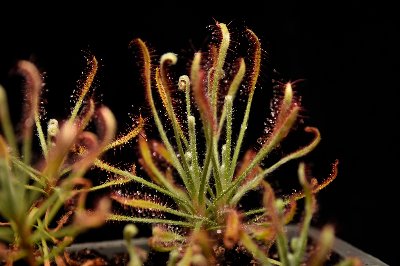
Drosera latifolia
{Paranapiacaba, São Paulo, Brasil}
A sundew with an identity crisis. Introduced to horticulture in the 1980s as "D. villosa", then grown for twenty years as "D. ascendens" after Fernando Rivadavia noticed it did not match the true D. villosa. Only when the real D. ascendens was finally rediscovered on the Diamantina Plateau did anyone realise this common species was actually D. latifolia, formally raised to species rank in 2014. Any plant acquired before then under those older names is almost certainly this one.
The most widespread member of the D. villosa complex, found across southeastern Brazil from Minas Gerais south to Santa Catarina. It grows at 700-2550 m elevation in campo rupestre vegetation, on quartzite sand, sandstone, clay and peat, usually near streams and seepages.
A perennial rosetted sundew with semi-erect leaves and pale pink flowers. Highly variable across its range, with at least six recognised geographical forms. This is the Serra do Mar form, which has a smooth, erect flower scape. Compared to its close relatives, D. latifolia has broader leaf blades and shorter petioles.
Our plants originate from Paranapiacaba, a historic railway village in the Serra do Mar at about 800 m, one of the localities examined by the describing authors.
16.00 €(2+ plants) ?