Drosera camporupestris
{Estrada para Macacos, Minas Gerais, Brasil}
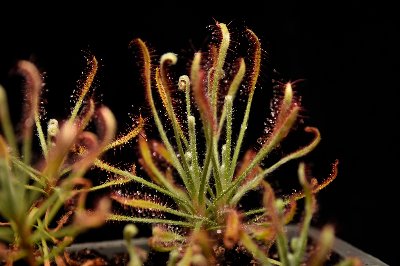
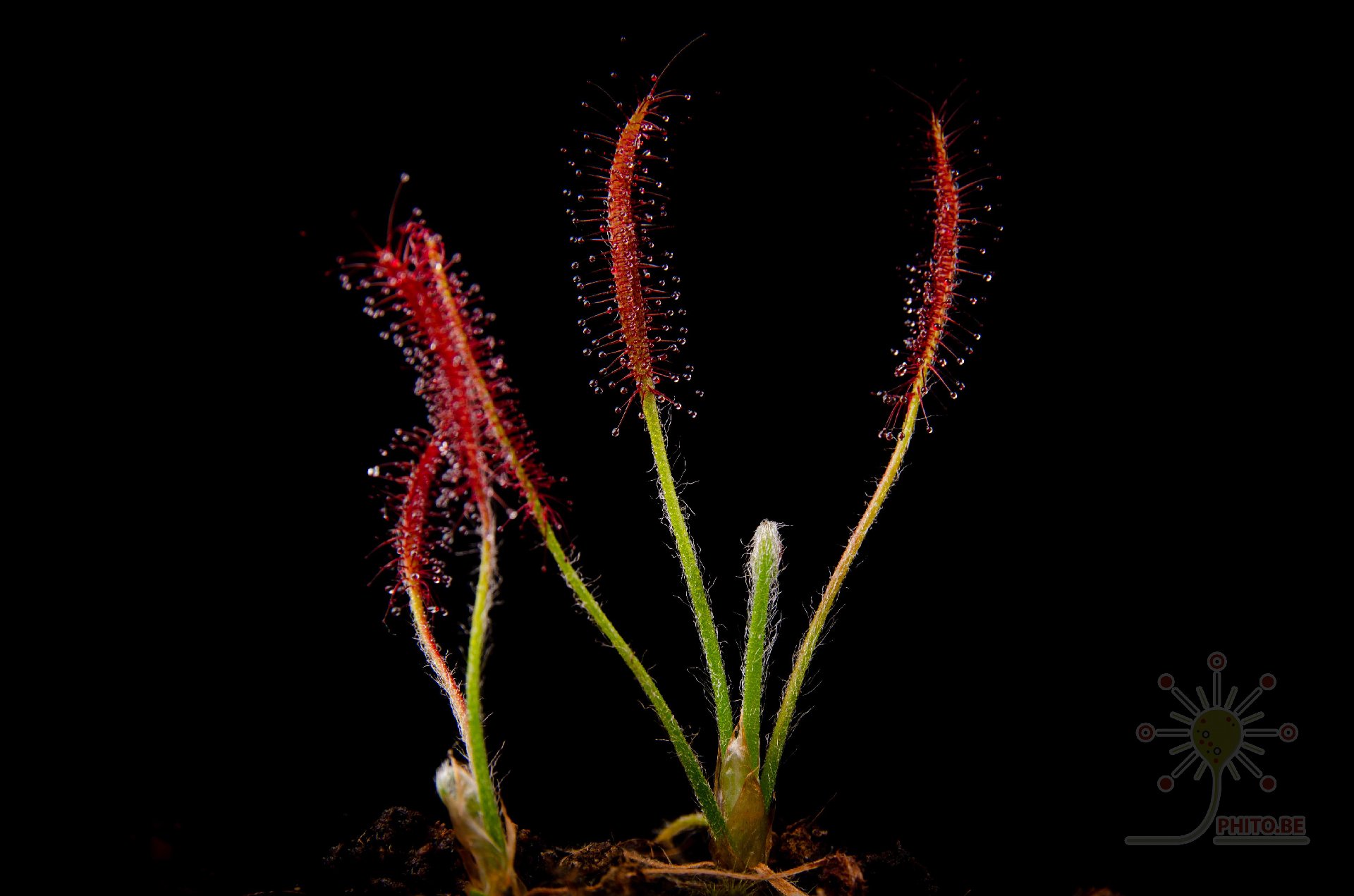
A stocky, intensely coloured sundew whose name literally means "of the campo rupestre", the rocky montane savannah biome of central Brazil. Described by Fernando Rivadavia in 2003, D. camporupestris is endemic to a handful of sites in central Minas Gerais: near Congonhas do Norte, Diamantina, Gouveia and the Serra do Cipo. The whole plant often turns a deep, saturated red that few other sundews can match.
It grows exclusively in seepage sites at 1100-1400 m, in sandy or humus-rich black soils that may be wet in summer but dry out completely in winter. Unlike many seasonal sundews, D. camporupestris does not go dormant, merely slowing its growth during the dry months.
Plants form short, thick stems (0.5-3 cm tall) bearing just 1-3 leaves with very long petioles (up to 10.5 cm) and narrow, hairy leaf blades covered in insect-trapping tentacles. Flowers are light to dark pink on tall scapes up to 23 cm. Closely related to D. chrysolepis, which is more slender with more leaves and shorter petioles. The two occasionally grow near each other but never together, and no hybrids are known.