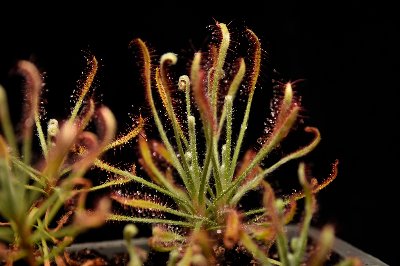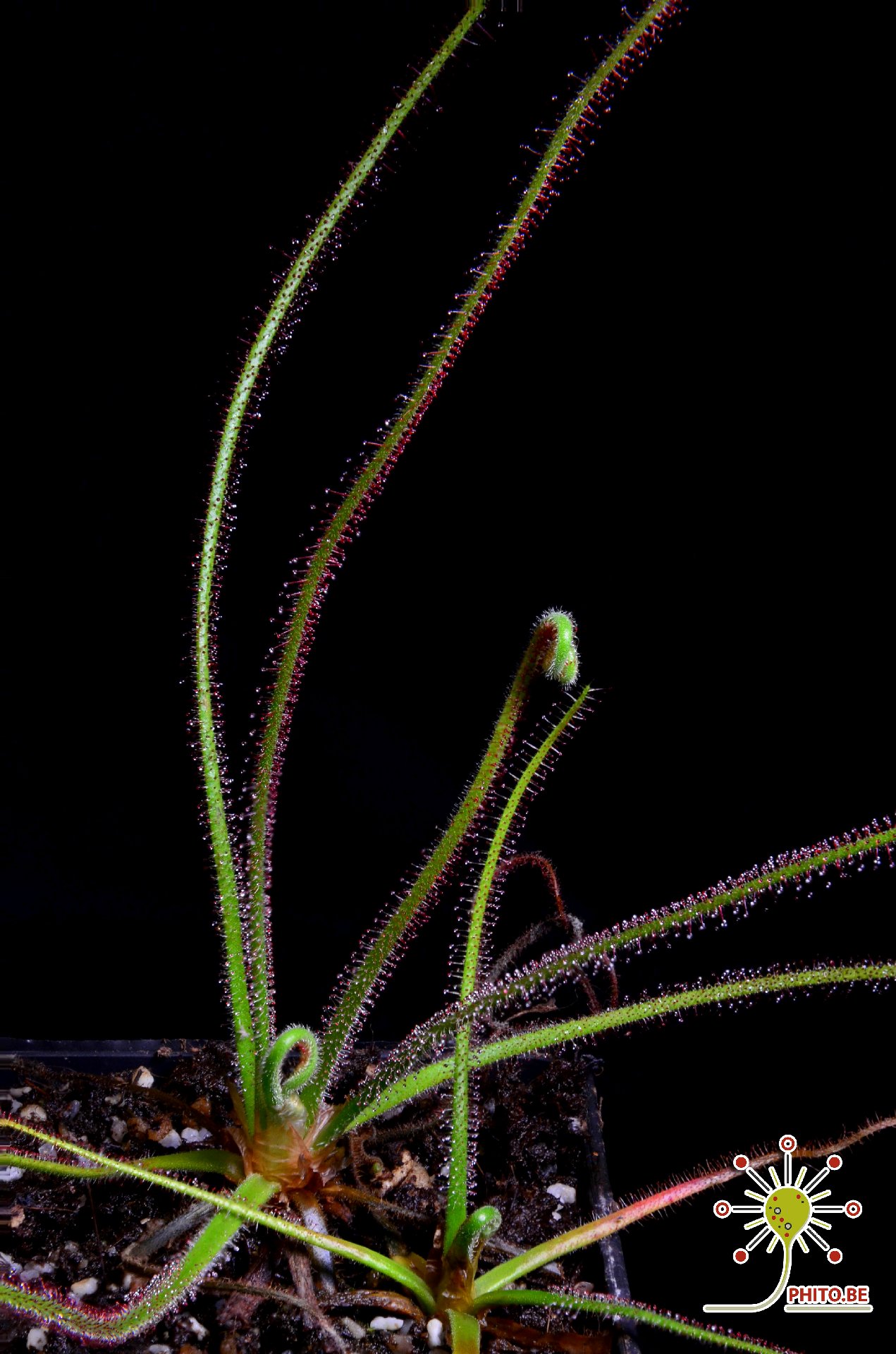
Drosera spiralis
{Itacambria, Minas Gerais, Brazil}
The only South American sundew that regularly bears insect-trapping tentacles on its sepals. This trait is extremely rare in the genus, making D. spiralis something of an oddity. The name refers to another distinctive feature: the narrow, erect leaves (up to 35 cm long) that spiral tightly at the tips as they develop. It was long lumped with D. graminifolia but re-established as its own species in 2012. The two are geographically separated and flower in opposite seasons.
Endemic to the Serra do Espinhaco in Minas Gerais, Brazil, mainly on the Diamantina Plateau with disjunct populations further north around Itacambira, Botumirim and Grao Mogol. It grows at 700-1500 m in campo rupestre vegetation, in sandy or peaty soils on quartzitic sandstone, often near seasonal streams and seepages. Plants are remarkably resistant to soil desiccation during the cool dry winter.
Flowers are light to dark pink, carried on scapes up to 43 cm tall. D. spiralis flowers from April to December (the dry season), the reverse of its close relative D. graminifolia, which blooms in the wet season.
This is the Itacambira form, from the northern part of the species' range.