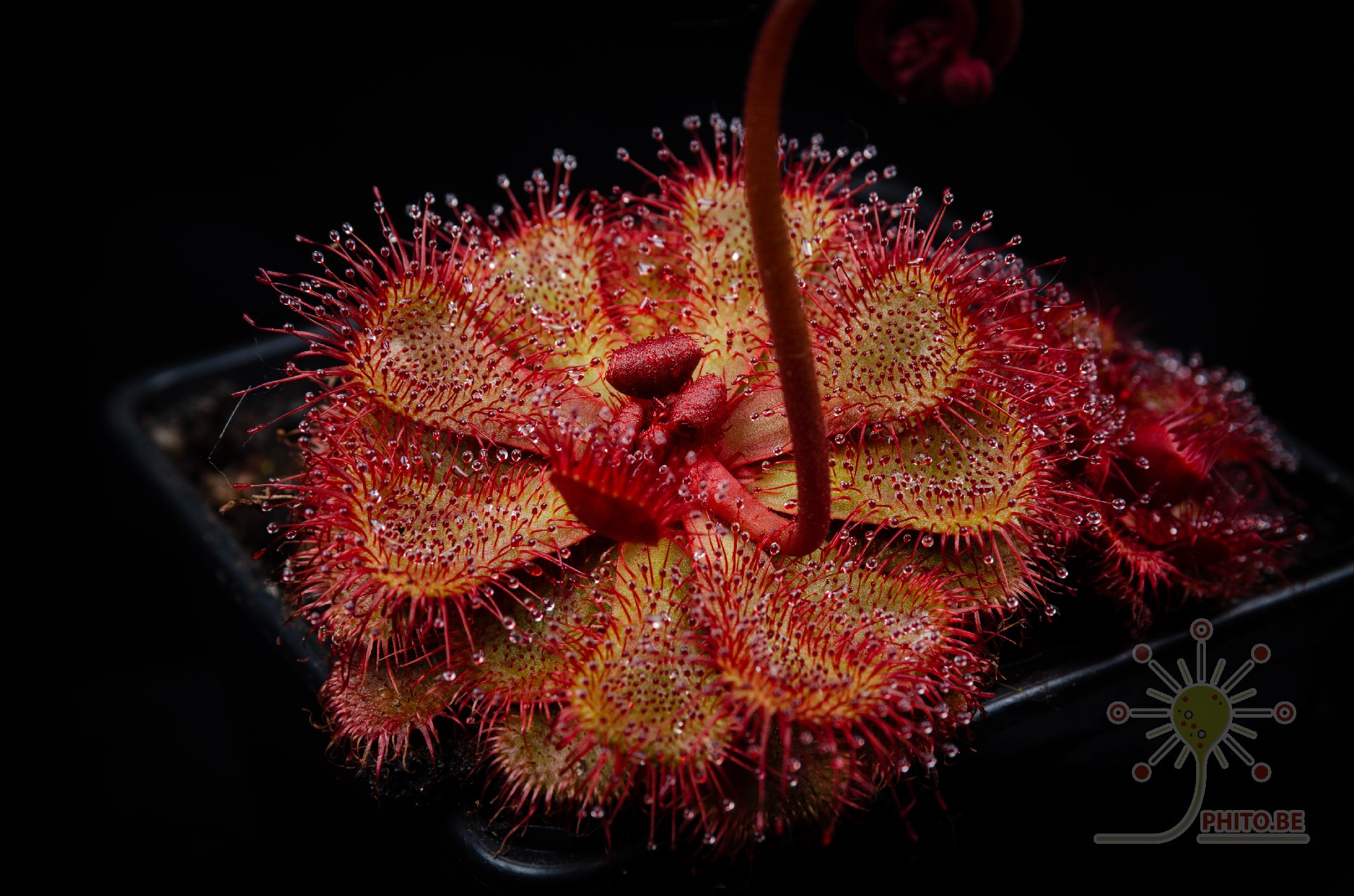
Drosera slackii
{Stanford, South Africa}
Named after Adrian Slack, the English grower and author who introduced it to cultivation in the early 1980s. Slack won five gold medals at the Chelsea Flower Show with his carnivorous plant displays and wrote two books that became instant classics in the hobby. The species was only formally described in 1987, remarkably late for a plant growing a short drive from Cape Town. Its entire wild range spans about 60 km along the Overberg coast, from the Kogelberg to Stanford, yet nearly all populations fall within the Fernkloof and Kogelberg Nature Reserves.
It grows in the Kleinriviersberg and Kogelberg mountains of the Western Cape, in wet peaty soil at the headwaters of small streams on Table Mountain Sandstone. Despite the Mediterranean climate, year-round coastal mists keep these seepage areas permanently moist.
Flat rosettes of 3-7 cm with distinctive fiddle-shaped, leathery leaves that turn bright red in sun. The thick red stipules and coarse red hairs on the leaf underside set it apart from D. aliciae. Plants form clonal colonies from a shared root system. Flowers are purple, but the species is self-incompatible: it needs pollen from a different plant to set seed.
This is the Stanford form, from the easternmost limit of the range. It has unusually broad leaves compared to the Hermanus and Palmiet River populations. Our seed was produced by swarm-pollinating several seed-grown individuals from the same Stanford accession.


