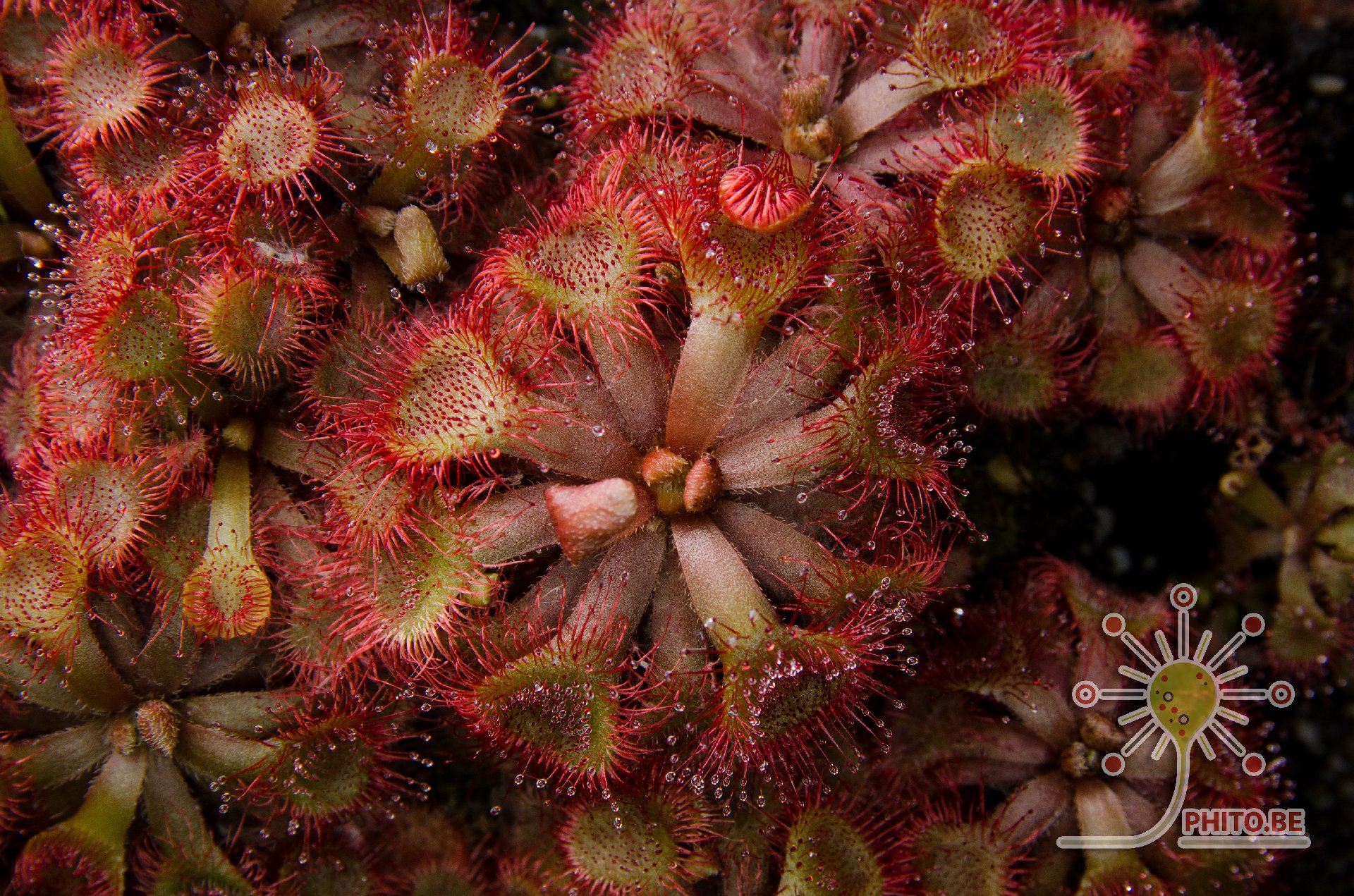
Drosera rubrifolia
Named rubrifolia, the red leaf. It was discovered by Eric Green, a Cape Town field botanist who spent decades exploring the Western Cape mountains. Green found it near Ceres and sent plants to Paul Debbert, who formally described it in 2002. Despite intensive searches at the type locality, the species was not found there again. Green's collections are the source of all material in cultivation.
It grows in permanently wet, peaty seepages along small streams in the mountains near Ceres and Tulbagh. These are cold, bright, high-altitude sites where water runs continuously over rock faces, in mountain fynbos country.
A compact flat rosette of 15 to 20 distinctly stalked leaves, each about 15 mm long, vivid red. The leaf blades are nearly circular, about 8 mm across. It looks superficially like D. slackii in colour and leaf shape, but is more closely related to D. aliciae: it shares its papery white stipules and fine white hairs on the leaf underside. Flowers are dark pink, in September.
16,00 €(2+ Pflanzen) ?


