Drosera hirticalyx
{Cerro Marahuaca, Venezuela}
A sundew from some of the most remote and ancient landscapes on Earth: the tepuis of the Guayana Highlands. Its type locality is Cerro Marahuaca at 2580 m, the second-highest mountain of the entire Guiana Shield. The name hirticalyx means "hairy calyx", referring to the long glandular hairs on the sepals, the key feature that separates it from the closely related D. roraimae. On Mount Roraima, where both species coexist, D. roraimae favours the plateau edges while D. hirticalyx is more common towards the interior.
It grows at 1200-2800 m across highland plateaus in Venezuela's Amazonas and Bolivar states, as well as adjacent Brazil and Guyana. You'll find it on sandy skeletal soils over sandstone, directly on bare rock, in moss mats, or on small islands of accumulated organic matter. These highlands are wet year-round, with no true dormant season.
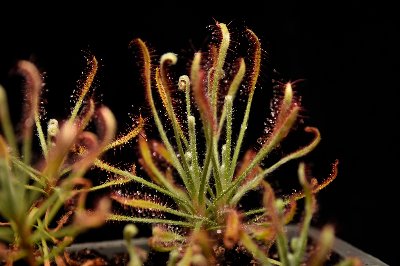
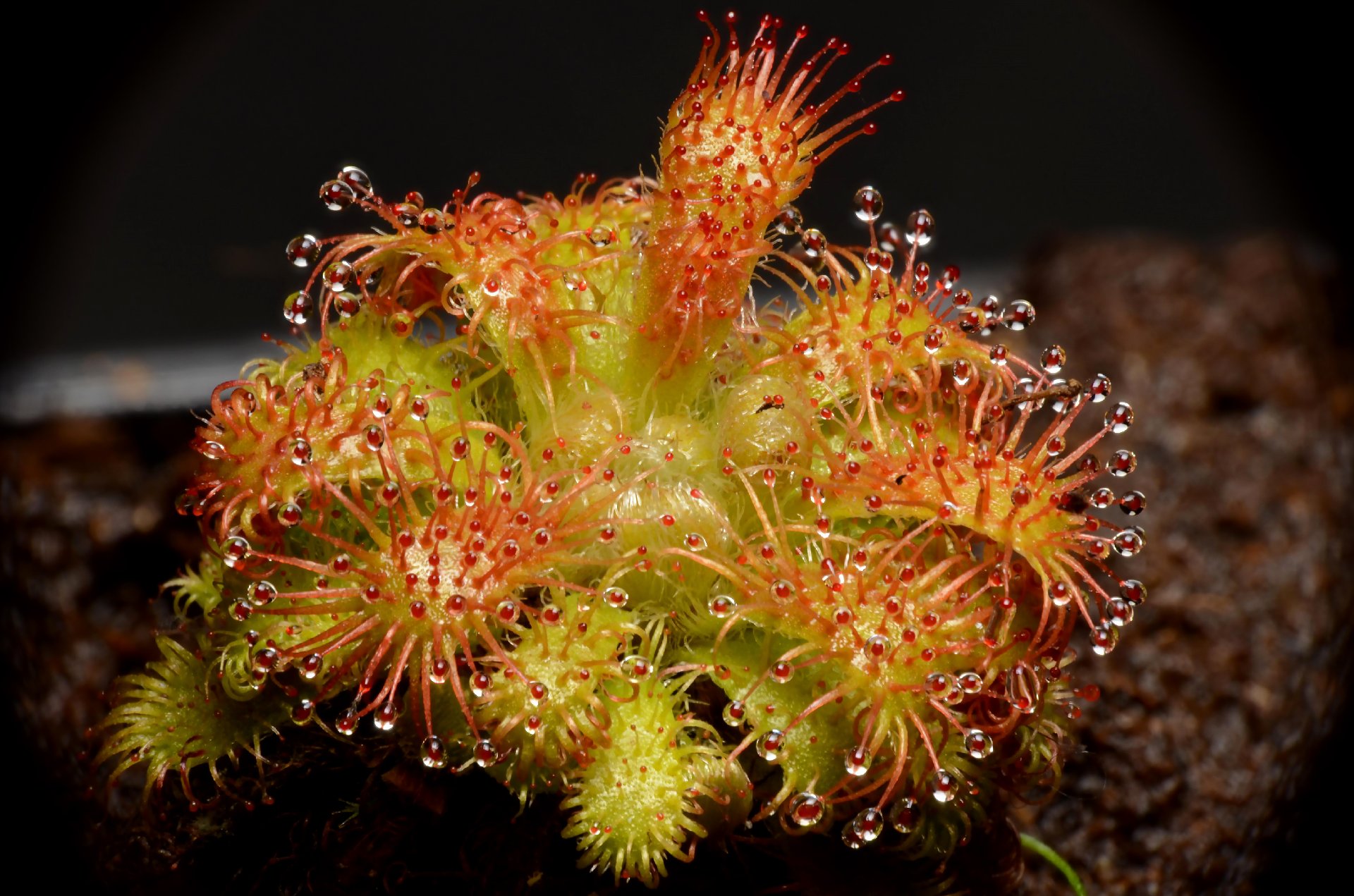
Plants form small rosettes of broadly spoon-shaped leaves (5-12 mm long) on short stems that build up columns of persistent dead leaves. This form tends to develop a golden coloration. Flowers are white, on erect scapes 4-15 cm tall with 2-6 blooms. Compared to D. roraimae, the leaves are about half the size, the petioles are less distinct, and the flower scapes carry fewer blooms.