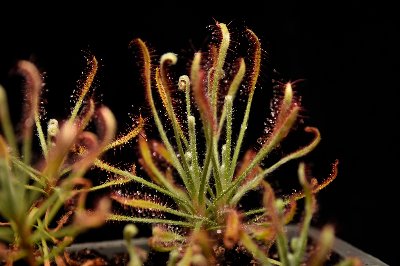
Drosera felix
One of only three neotropical sundews that disperse their seeds by rain. The seed capsules open like tiny cups on stiff upright stalks, and when raindrops hit them, the round seeds bounce out and scatter. The other two species with this trick are D. kaieteurensis and D. solaris. The name felix is Latin for "happy", given as a cheerful welcome when botanist Lyman Smith first entered Venezuela's Gran Sabana, introduced to the region by Julian Steyermark in 1974.
It grows at 1200-1500 m in southeastern Bolivar state, Venezuela, close to the borders with Guyana and Brazil, though its presence in those countries is not confirmed. You'll find it in damp to wet areas on white quartzite sand and on wet sandstone near seepages. Plants can sometimes be found growing partly submerged.
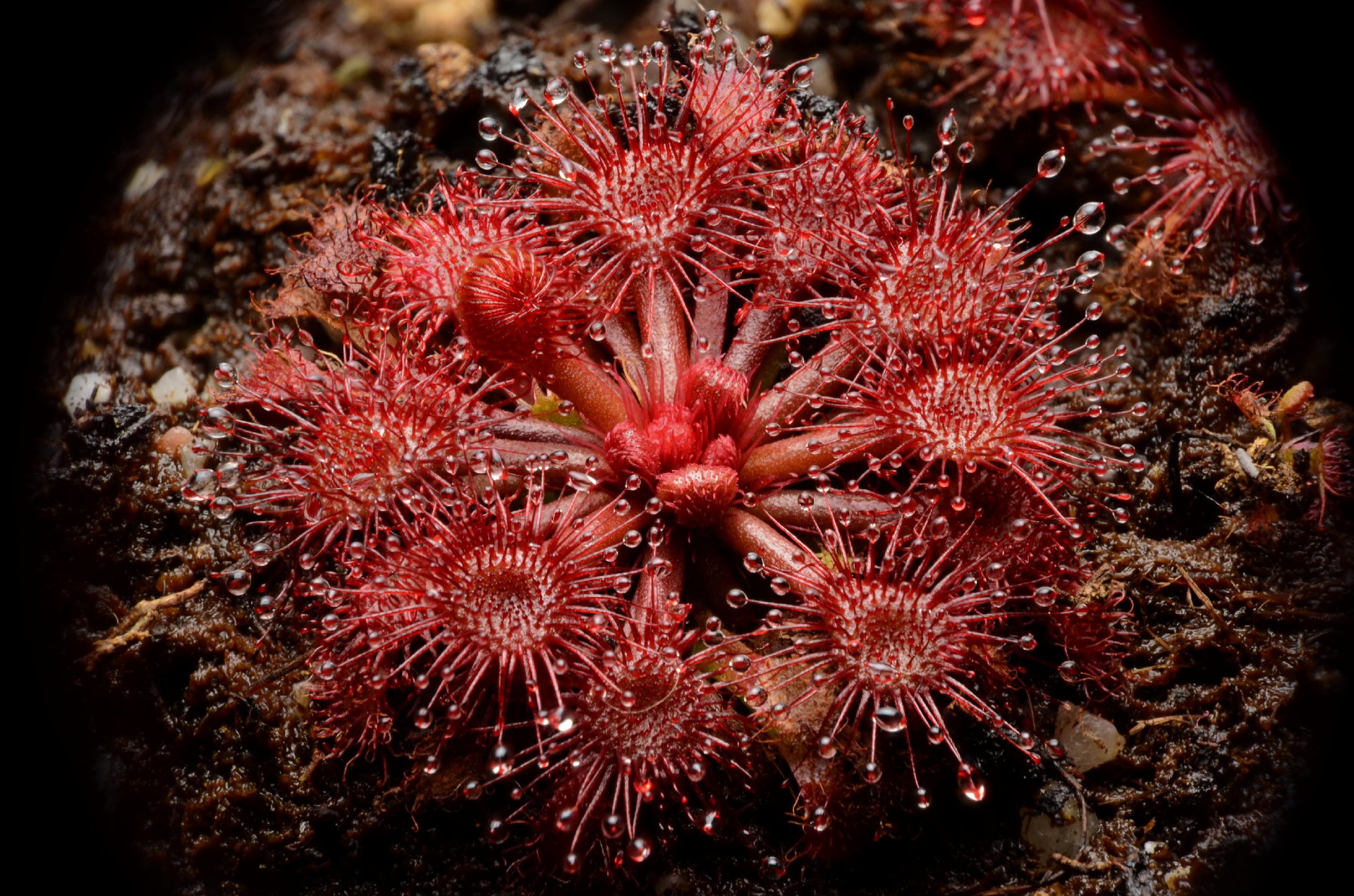
A tiny species. Plants form small rosettes of 6-10 spoon-shaped leaves with nearly round leaf blades about 3 mm across, on short stems that can build up small columns of dead leaves. Flowers are white, on very short scapes (1-20 mm) with just 1-2 blooms. It looks similar to D. kaieteurensis, but is smaller in most respects: shorter scapes, fewer flowers, and it does not form branching stems.
16,00 € 12,80 € -20%(2+ planten) ?