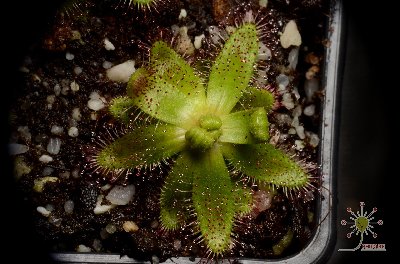
Drosera coccipetala
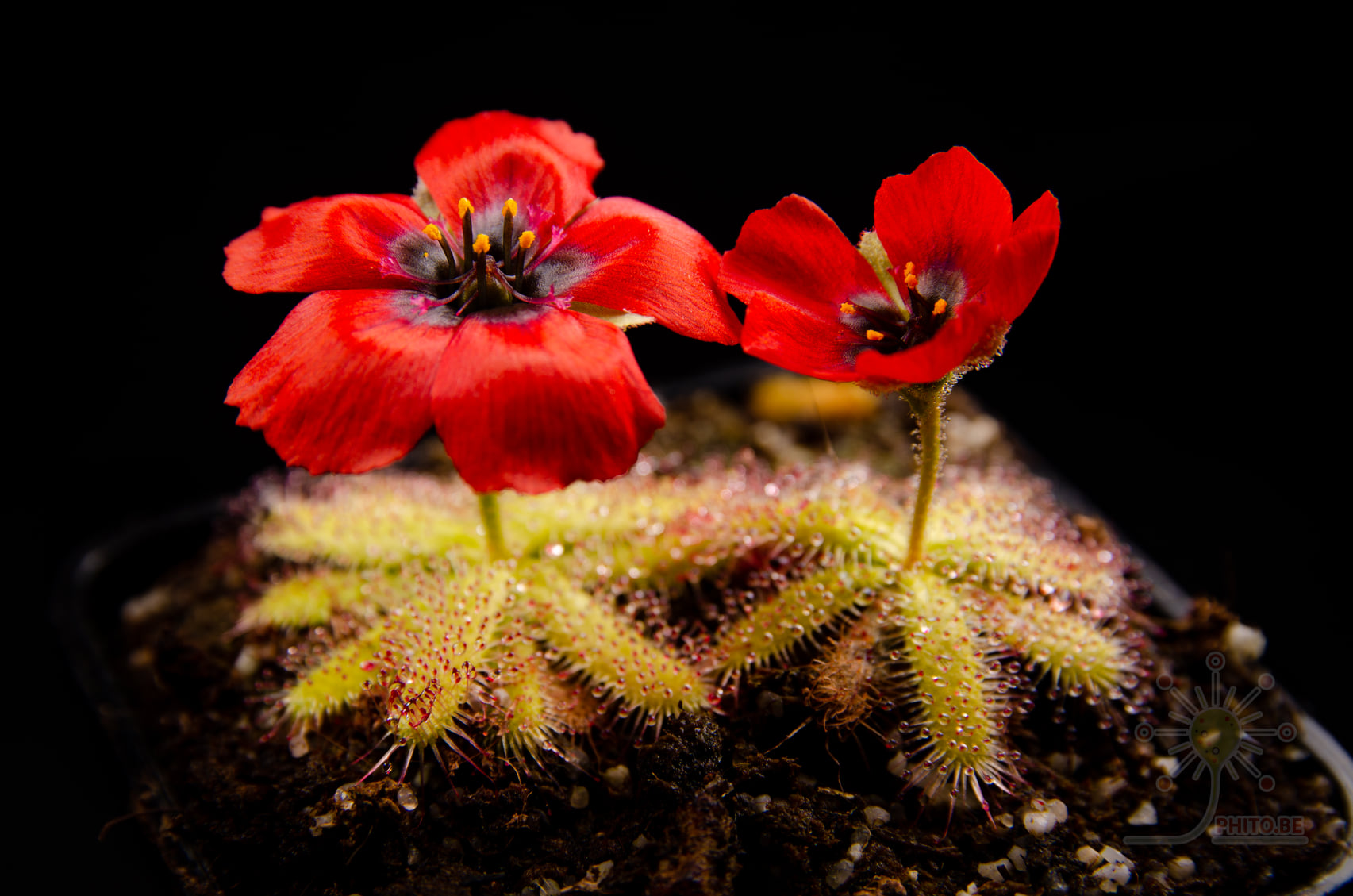
Bright red flowers with a dark centre. Most sundews have white or pink flowers. True scarlet is almost unheard of in the genus, and it is what gives this species its name: coccipetala, from the Latin for "scarlet petal." The dark grey petal bases, black filaments and black ovary complete a colour scheme closer to a poppy than a sundew. Described by Debbert in 2002.
Endemic to a small area near the town of Caledon on the south coast of the Western Cape, South Africa, where it grows in seasonally moist clay loam among low fynbos heathland. Winter-growing: active during the cool, wet Cape winter and dying back to its roots in summer. The range is tiny and its survival depends on local farming practices, as the lowland Overberg has lost over 95% of its original vegetation to agriculture.
A small flat rosette, 2 to 4 cm across, with narrow leaves. Flowers appear in August and September (February and May in our hemisphere) on short stalks bearing just one to three blooms. Sometimes confused with D. zeyheri, which also has dark petal bases, but D. zeyheri has white, pink or cream flowers, never red, and can form leafy stems above the rosette.