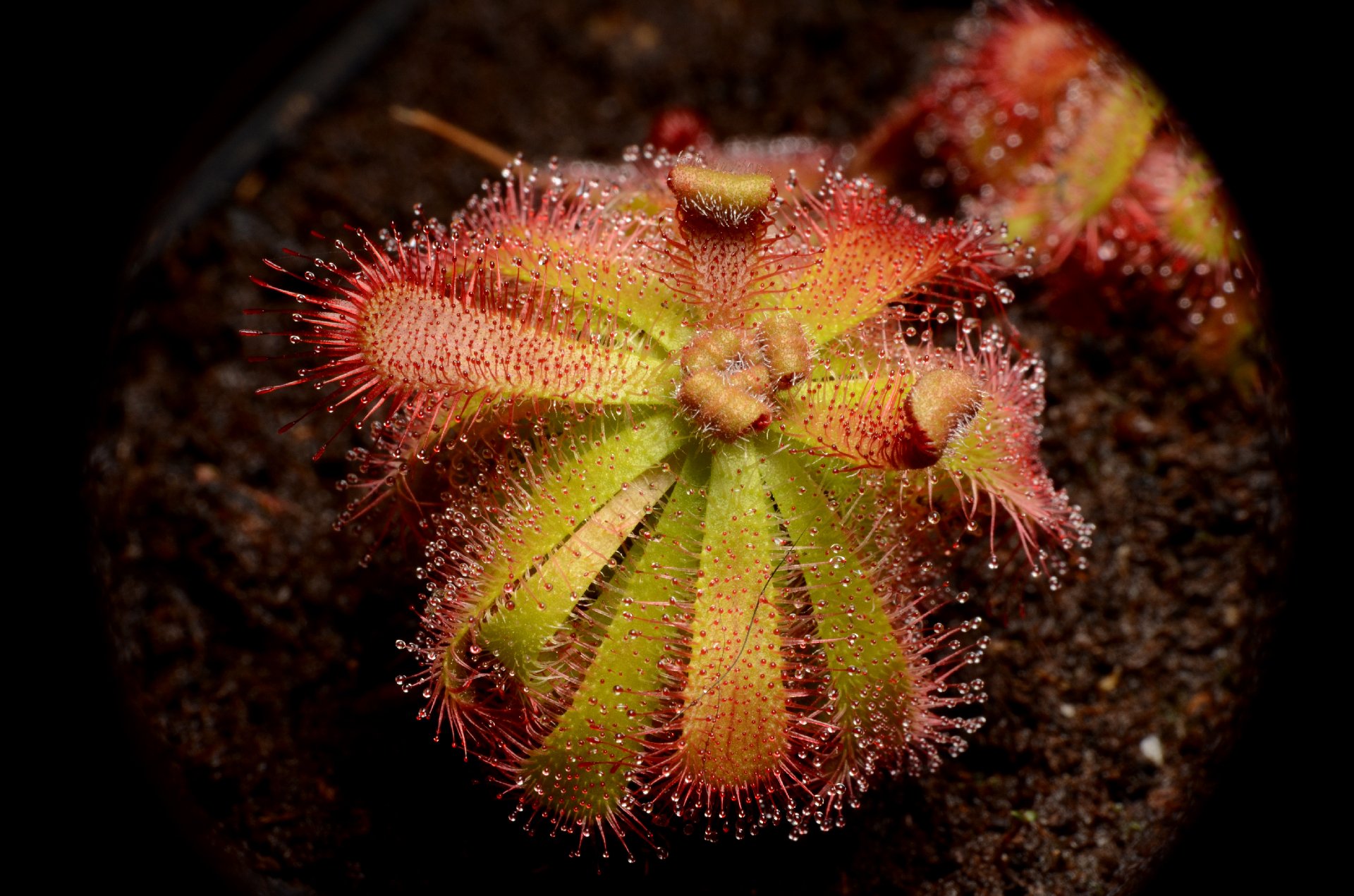
Drosera afra
{Ceres, South Africa}
A species that exists in a taxonomic grey area. Described by Paul Debbert in 2002, D. afra is not accepted by everyone: POWO (Kew) and the monograph "Drosera of the World" lump it under D. trinervia, but the Carnivorous Plant Database argues the well-developed stipules mean it "cannot be related to D. trinervia." Other differences support the split: D. afra has pink flowers (vs typically white in D. trinervia), larger rosettes (3-4 cm vs 2-3 cm), and a preference for mountainous seepages rather than the generalist wet habitats that D. trinervia occupies across a much wider range.
This is a winter grower from the mountains around Ceres in the Western Cape, South Africa. The Witzenberg and Hex River ranges surround Ceres, with peaks reaching over 2000 m. D. afra grows on sloped, wet rock faces and seepages in mountain fynbos, in a Mediterranean climate with cool, rainy winters and dry summers. Plants go dormant in summer, surviving as fleshy rootstocks.
Rosettes of long, strappy leaves that turn vivid red under strong light. Flowers are pink, carried on tall glandular scapes. Self-fertile and can set seed without cross-pollination.


