Drosera ultramafica
{Mt. Mantalingahan, Palawan}
Named not after a person or a place but after its soil. Ultramafic rock is rich in magnesium and iron and toxic to most plants. D. ultramafica is confined to these substrates, and the authors who described it in 2011 speculated the plant may even hyperaccumulate heavy metals in its tissues. It had been hiding in plain sight for decades, lumped under D. spatulata. Van Steenis noted the differences as early as 1953, but it took nearly sixty years for a formal description. Most old records of "D. spatulata" from tropical Asia actually refer to this species.
Scattered across ultramafic peaks of the Malay Archipelago: Palawan, Borneo, Sumatra, Sulawesi. Widespread in range but extremely localised, each population confined to a single mountaintop. This is the form from Mt. Mantalingahan, the highest peak in Palawan at 2,086 m. Plants grow at 1,400 to 3,000 m in crevices and on ledges of ultramafic rubble, in bright, open areas where few other plants can establish. At Mt. Mantalingahan it shares its habitat with the pitcher plant Nepenthes mantalingajanensis.
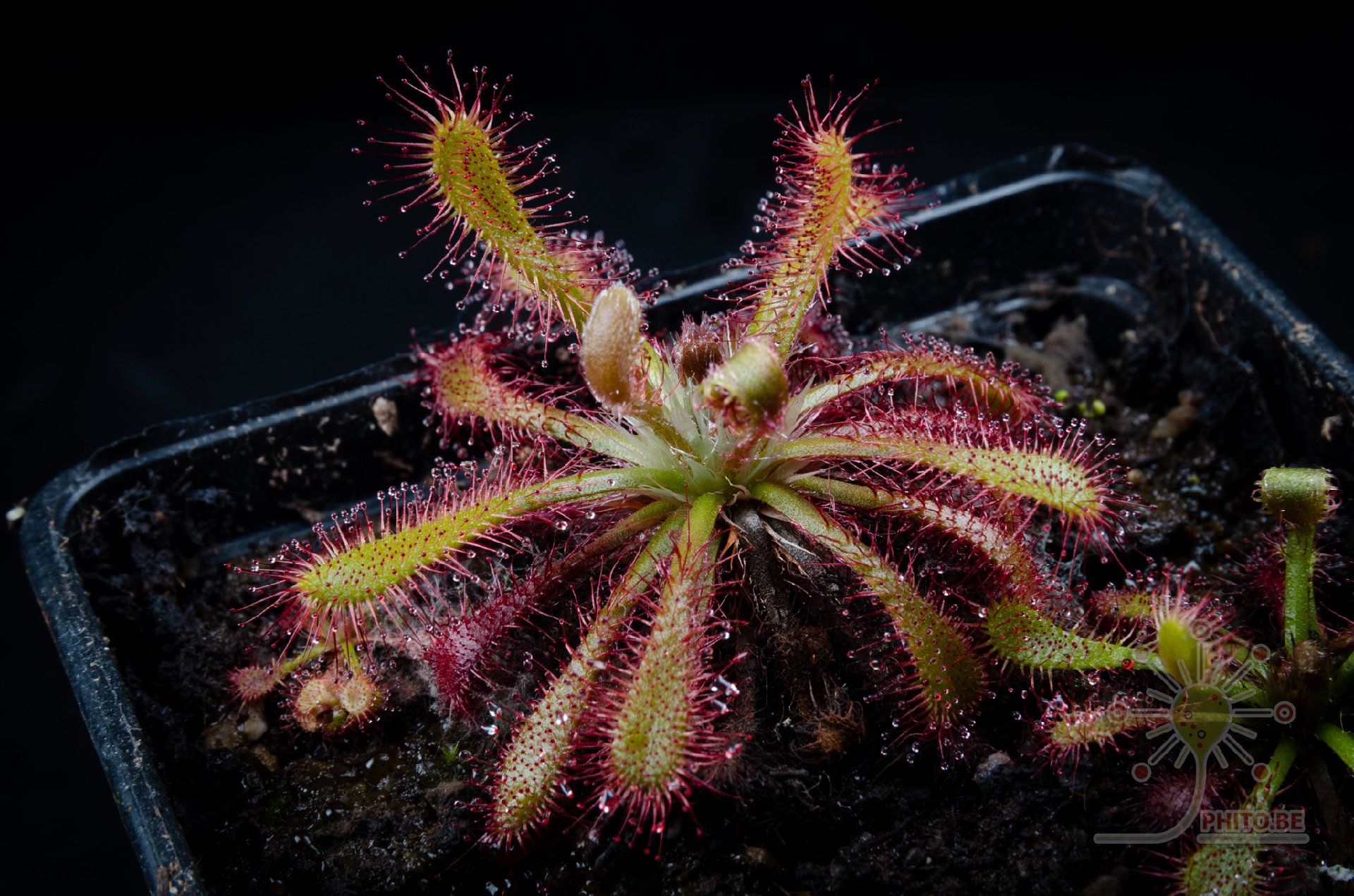
A stem-forming rosette up to 5 cm across, with semi-erect leaves that give the plant a rounded, ball-like profile, unlike the flat rosettes of D. spatulata. Leaves are green to red in strong light, flowers white or pink. D. neocaledonica is the only other sundew apparently restricted to ultramafic soils.