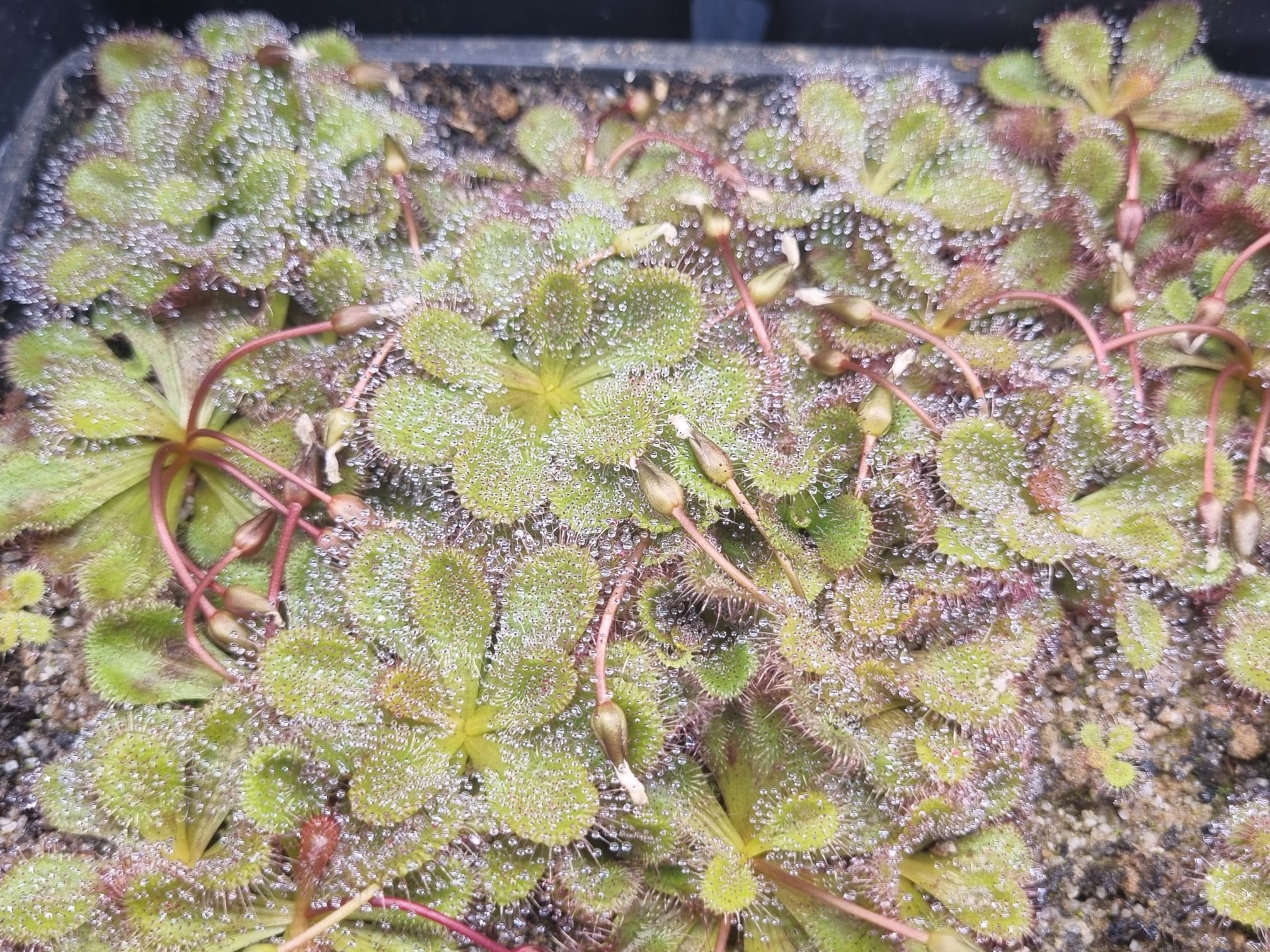
Drosera aberrans
TUBERS
A tuberous sundew that spreads by sending out runners. Most tuberous Drosera reproduce by seed or by forming a single replacement tuber each year. D. aberrans does something different: it produces stolons, underground stems that creep outward from the parent plant and form new tubers at their tips. Some stolons even break the soil surface, carrying tiny leaves with glandular hairs before diving back underground. This colony-forming habit is what earned it the name aberrans, Latin for "departing from normal," because it sets the species apart from its close relative D. whittakeri.
Widespread across the inland southern mallee regions of South Australia, from Gulf St Vincent and the Mount Lofty Ranges east through southern and central Victoria. Common enough to turn up in suburban parks around Melbourne and along railway cuttings. Grows in a wide range of soils, from sands to lateritic gravels to limestone-derived clays, in mallee woodlands and shrublands.
A flat rosette of 8 to 12 leaves, green to orange-yellow or red with age. Leaves are broadly spoon-shaped, 5 to 11 mm long. Flowers are white, large for the plant's size (up to 24 mm across), appearing from July to September. Like all tuberous Drosera, it retreats to a pale orange tuber underground over summer.
12,00 €(2+ planten) ?
